Monday, August 3, 2026

Essential safety guidelines when encountering orangutans on forest pathways in Tanjung Puting NP

On a recent viait to the Tanjung Puting National Park, Wow Borneo guests encounter a mature male orangutan, known as Roger Danuarta, the King in Tanjung Harapan. Adult male flanged orangutans fight for dominance within defined ranges in the forest, which gives them sole access to the females and the lion's share of the food on the feeding platforms and in their favourite fruiting trees.

Following instructions from the guides in these cases, our guests move to the side of the trail, remaining still and not making eye contact.


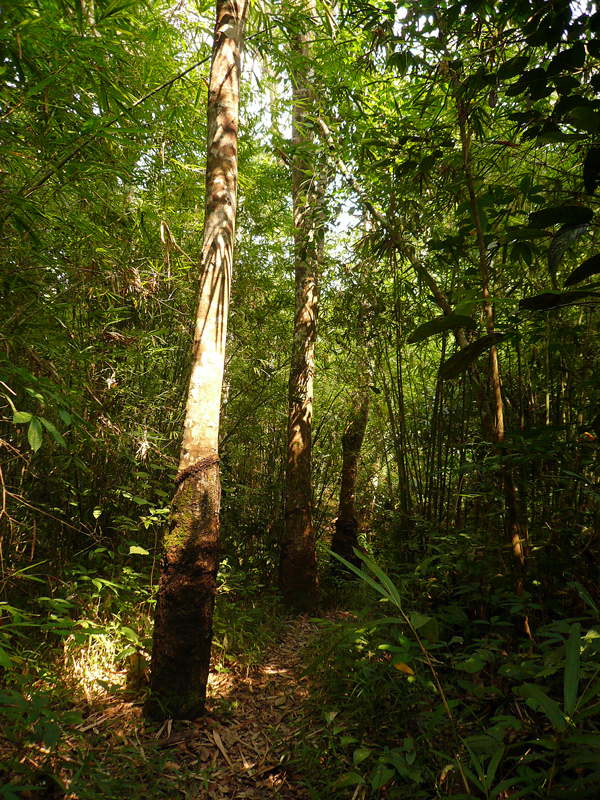
Orangutans are arboreal, and spend most of their day in the tree canopy, descending to forage on the forest floor for ants nests and other delicacies. In the lush peat-swamp forests of Tanjung Puting National Park, these solitary primates spend their days traveling methodically between fruiting trees, stripping bark for vital nutrients, and weaving intricate sleeping nests out of fresh branches high above the ground each evening. If you do encounter an orangutan on a forest pathway, here are the guidelines on what to do:

Essential Safety Guidelines for Park Visitors

Because many orangutans in Tanjung Puting are semi-wild or rehabilitated, they may show little fear of humans—making strict precautions essential during forest treks:

  • Maintain a Safe Distance: Stay at least 5 to 10 meters (16–33 ft) away from all orangutans. Never attempt to approach, touch, or pose for photos close to them.

  • No Food or Drinks: Do not carry visible food, snacks, or flavored drinks into the forest. Orangutans have an acute sense of smell and may aggressively confiscate bags to get food.

  • Never Feed Them: Supplementary feeding by visitors breaks park rules, alters wild foraging behavior, and increases the risk of dangerous confrontations.

  • Prevent Disease Transmission: Orangutans share over 97% of human DNA, making them highly susceptible to human illnesses. If you feel sick or have a cold, wear a mask or stay on the klotok (boat).

  • Give Dominant Males Space: Flanged adult males are exceptionally powerful—weighing up to 200 lbs—and can turn unpredictable if they feel cornered or challenged.

  • Always Defer to Your Local Guide: Never wander off designated trails alone. Local guides read orangutan body language and know when an individual is showing signs of distress or territorial aggression.

  • Please wear light not bright colours, no camera flashes, quiet whispers only and no littering.

  • Take only photos, kill nothing but time and leave only footprints.


Thursday, June 4, 2026

Cruising the Sebangau National Park

Close to Palangka Raya is the unique Sebangau National Park - it is home to thousands of truly wild orangutans. They are not easy to see, and their habitat is peat swamp forest, but they can sometimes be spotted in the treetops from canoes as we pass quietly along the narrow canals crisscrossing the park. There is plenty of other wildlife, with flashes of hornbills, kingfishers, noisy proboscis monkeys, and early-morning gibbon songs.


One of the joys of my job is exploring the rivers, experiencing the wildlife in the abundant forests, meeting the people, learning about their livelihoods and then bringing guests in to appreciate their tenacity and resourcefulness. Without road access, the river is the highway, and without power, town water, or much food production, these people have sustained their lives by adapting to local resources. 


Climbing into simple local canoes, the villagers take us on a journey through their backyards. Along narrow canals and across vast blackwater lakes, we spot wildlife and enjoy its peaceful timelessness.


Being largely dependent on their local environment for food, they share a feast with us consisting of river fish and forest greens. Huge river prawns are a special treat!
Wow Borneo operates the only tourist boat in the area. This is a special remote location, and we have designed a 5-day cruise to take you away from it all on a comfortable vessel with our great local guides and fantastic onboard cooks.


Monday, April 28, 2025

The Old Village at Tumbang Malahoi

 Recently we spent a long day visiting this Dayak cultural gem, and can highly recommend it! For the slow traveller, who could choose to sleep in the longhouse and tune into the pace and character of the place over 3 days, or for those having time only for a quick day trip from Palangka Raya.

The village of Tumbang (or confluence of rivers) Malahoi is sited where the Malahoi River joins the much larger Rungan River, which is in turn a tributary of the Kahayan River. The Kahayan runs through Palangka Raya on its way south to Bahaur, on the Java Sea. This web of waterways was once the transport route for communication, trade, and culture, but it is now mostly used by barges carrying raw materials for export. People journey along the much faster roads.

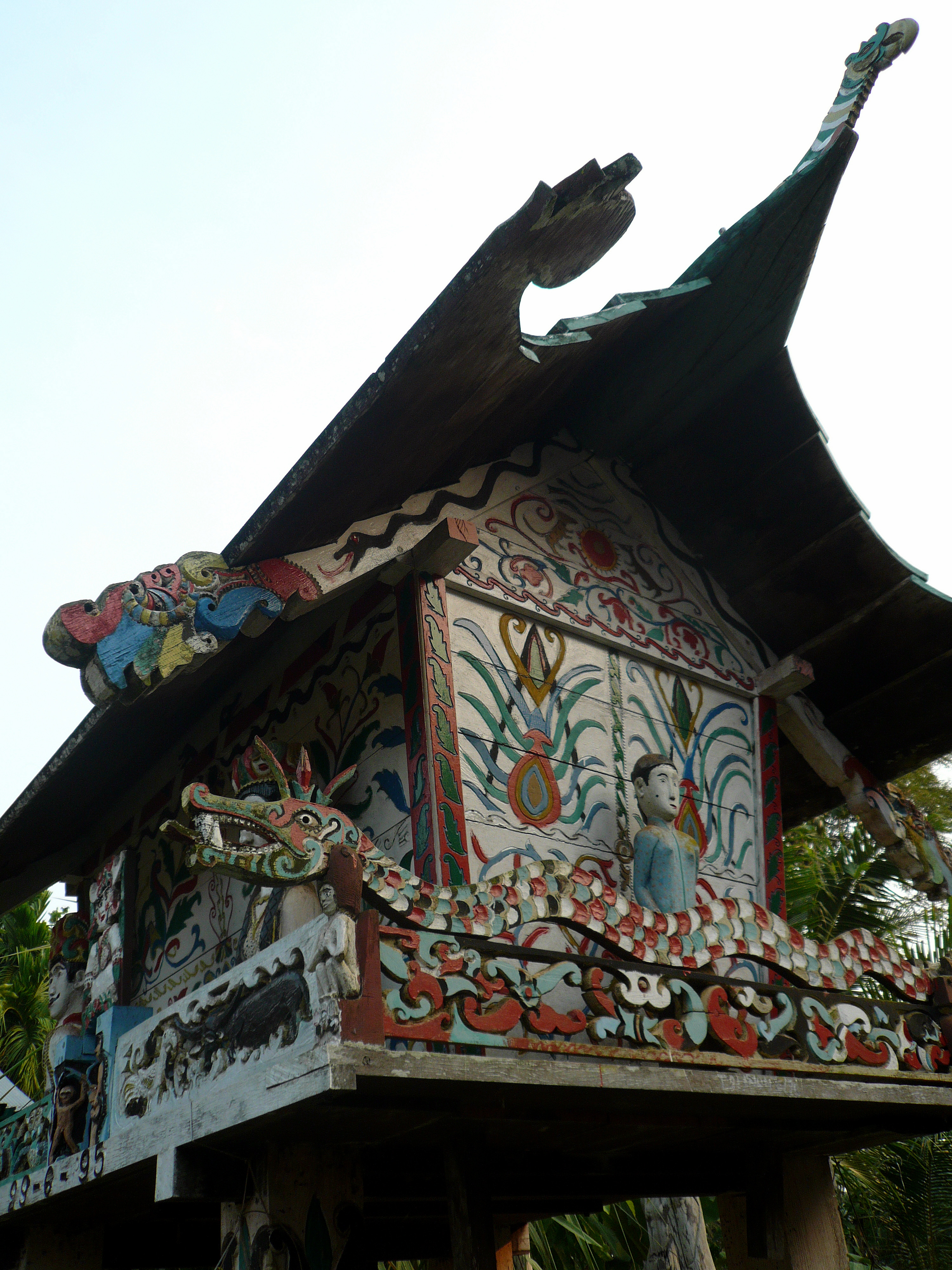
There are some remarkable ossuaries or Dayak bonehouses (sandung) alongside the road on the way to Tumbang Malahoi which are worth a closer look. This one is owned by a Dayak family, who have repainted and extended it, still living with the old traditions, and happy to chat with visitors.


A leisurely stroll around the picturesque village rewards the visitor with many brilliantly painted sandung, all raised beside the homes of families of the ancestors in whose memory they are built. The decorations have significance to those whose bones are lying inside. They are surrounded by little effigies and scary masks protecting the area from mischievous spirits.


The original longhouse still stands with its ironwood bark wall coverings, the totem poles or Sapundu, and Sandung. These remain there, inviting guests to climb the notched pole to enter the living area. It is possible to stay here a few days, to enjoy the warm hospitality of the longhouse inhabitants, the slower pace of living in a Dayak village and learn more about the resilient lives of the people.
This photo was taken almost a decade ago by frind John Boyd Macdonald, whose wonderful Blog of his travels with his wife Karen around Kalimantan makes for rewarding reading.  It so captures the sense of vivid and almost chaotic life experienced in these remote places.


Wednesday, September 4, 2024

Wow Borneo receives TripAdvisor's 2024 Travellers Choice Award


 The brilliant flash of the Kingfisher is often seen along the rivers of Central Kalimantan

Monday, September 18, 2023

The Grand Old Lady of the Kahayan River

Recent renovations to the Rahai'i Pangun improved the cabins, added ensuites and replaced equipment. She is returned, happily plying the river she has serviced for 50 years. A grand old lady, she was built in the locally famous Mandomai carpentry school near the regional capital of Pulang Pisau on the Kapuas River. Built solely from the first-grade hardwood called ulin growing prolifically in those days, she has outlived many other vessels on the river. Launched with the name Noah, she was purchased by Wow Borneo in 2014 and comprehensively converted and upgraded. We take maintenance seriously, and in spite of the worst possible conditions - extreme tempratures, heavy rain and widely variable river conditions - she continues to live up to her new name, Rahai'i Pangun. It means big development in Dayak, and she continues to pioneer a river tourism industry along the Kahayan River.


Thursday, May 5, 2022

The improbable proboscis monkey


Nasalis larvatus is a large, exquisitely coloured and graceful monkey that is a native of the rivers, swamps and coastal mangroves of Borneo. It is classified as endangered in the IUCN Red List of Threatened Species due to habitat loss, illegal poaching, and land conversion.

Among the largest of Asia's monkey species, they are found in energetic groups along riversides often near the sea. This guy is photographed by the side of the Sekonyer River, along the boundaries of the Tanjung Puting National Park. Like orangutans, the proboscis or bekantan (as it is locally known) is one of the Bornean flagships that faces serious threats to its population.
 

It may seem hard to believe, but male proboscis monkeys probably use their out-sized noses to attract mates by amplifying their calls to mates and rivals. They are a highly arboreal species, making spectacular leaps through the canopy, and will venture onto land only occasionally to search for food. They live in organized harem groups consisting of a dominant male and two to seven females and their offspring. Various groups often congregate near water at night to sleep.

Apart from their unique noses and elegant colouring, with the long pure white tail, Proboscis monkeys are the primate world’s most prolific swimmers. They can often be glimpsed crossing rivers in search of food, using their webbed feet and hands to help them outpace the crocodiles, which are their main predator. Over the last 40 years, proboscis monkey populations have plummeted. They are currently protected from hunting or capture in Borneo.

Join Wow Borneo's cruises into Tanjung Puting National Park and to the Sebangau National Park to glimpse these improbable and highly specialised creatures in their native habitats!

Friday, April 15, 2022

Longhouse at Tumbang Manggu

On the Samba tributary of the Katingan River sits this stunning longhouse or betang at Tumbang Manggu. Although constructed over the last 3 decades, it is conceived on traditional principles, using the endemic trees from the once embracing forest - notably massive ironwood treetrunks. Many meters high for safety from annual floods, marauding animals and rival tribes, it was built and occupied by a Dayak family who is locally famous for traditional crafts and especially for dance. Here below is Chechen prepared to perform the sword dance in traditional garb. He trains a village group in dance and the accompanying rituals. Here he is seen on the niched pole which gives access to the betang.


The betang is sensibly located above the river's course and close to a well-established village. One of the delights of staying here is to set off on exploring strolls around the village to find the many examples of carvings created to honour the ancestors who are interred in the magnificent raised bonehouses or ossuaries. The totem poles may depict the departed souls and events in their lifetime. Some illustrate the manner of passing, but all are decorated in highly ritualised symbols and colours. Hornbills are the vehicles for the souls as they travel to heaven and the ferocious beasts keep away troublesome spirits.


The betang itself, although imposing, with beautiful carved posts and elaborate stair access, is simple inside with spaces provided for gatherings and with memorabilia lining the walls. Photos of ancestors and the extended family are fascinating to see. Guests rooms line the side of the meeting area. Meals are served on the balcony or inside a smaller family gathering space. Traditional instruments, the array of gongs, and beaded cloth worked by the inhabitants hang on the walls. Rattan baskets for gathering jungle foods and the traditional long machete or pisau also hang there, ready for the next foray into the forest, to trim the prickly rattan vines or dig up some wild tapioca bulbs.


Village strolls and walks to the nearby ladangs or family cropping areas yield so many interesting sights and meetings. The village shops line the high street with a few simple eating houses. Passers by have a ready smile. After the shops, houses line the river bank, and interspersed with those are the bonehouses.


All remaining occupied longhouses are distant from the city, and only accessibe along bumpy roads and swift rivers. Not for the faint-hearted or luxury lovers, these places are closest to the real life of the longhouse. Every year, communications improve, the adjacent forestry company expands and fells more timber, and the modern world encroaches further.

But the passion of the dancers remains!