Be the first to experience this new route from info@wowborneo.com.
Wednesday, October 5, 2016
A Walk in the Sebangau National Park with WOW Borneo
We're opening a new cruise route on the Katingan River from November 2016. Explore with us the Sebangau National Park, traditional Dayak communities, float over the perfect reflections on black water lakes, watch as the thorny rattan vines are woven into beautiful mats, all accessible from the Katingan River and our adventurous little boat, the Ruhui Rahayu. The Sebangau National Park is home to the largest population of wild orang-utans in the world, as well as many other endangered species such as the Malayan sun bear, gibbons, hornbills and the clouded leopard.
Be the first to experience this new route from info@wowborneo.com.
Thursday, September 1, 2016
August and September dry season cruising
Last year, we experienced an El Nino long dry season marked by smoke from land clearance fires. This year, with the promised La Nina weather effect, a few dry weeks in August may be giving way to an early onset of the rains. Today, as I write this, heavy rains are falling in Palangka Raya. A few days ago, I joined a cruise on board the Rahai'i Pangun and experienced the lower water levels and baking heat of the end of the dry. The clear skies and rich morning and evening light were the perfect conditions for photographs.
A special treat, in the slow, grinding heat of the afternoon, was glimpsing a family of otters on a nearby sandbank, come out of the forest for a spot of sunbathing, before skipping off in the direction of a fisherman's net. Goodluck little fellas!
Sunday, May 22, 2016
Spectacular and little known Gagu Longhouse
Tumbang Gagu Longhouse was founded in 1870 using the traditional Dayak method of releasing a chicken and seeing where it roosts. In an isolated area, on a rising by a pretty rivulet, the longhouse was built by traditional owners, mainly village head Singa Raja Antang bin Lambang Dandu, after a grant from the Dutch and Antang's own personal wealth made it possible. Close to the sources of his wealth in the abundant forests nearby, strategically placed on his export routes to the port at Sampit, the longhouse became home for his 3 wives, each in her own apartment, with the other families.
55 meters long, it is built in the traditional style atop huge ulin ironwood tree trunks and other supporting poles numbering well over 200. Roughly hewn by adzes and towering 5 meters over the sloping ground, the longhouse provides protection and shelter for the families living in the midst of the forest. The niched poles leaning against the longhouse give slippery access, but may be quickly raised if trouble looms.
The longhouse remains in the hands of descendants of the original owners, though currently only two families live there. In the central apartment live Antang's grandson, Pak Labuang and his wife, Ibu Leri, now old but determined to keep the tradition and majesty of the longhouse alive.
A village has grown up nearby and natural resources are still being mined from the abundant natural environment. Gold mining is a dirty and inescapable feature of the waterways, most large trees have now gone, traditional slash and burn agriculture is penetrating the re-growth forests, and banana plantations are springing up in their wake.
About 7 hours from Palangkaraya by road, and a further hour by speedboat on the Katingan River, the last leg to the longhouse is by foot, just over 2 hours along a hilly forest trail. Long periods of rain made the rivers misty and the trail slippery and flooded.
From the outset, losing all phone signals was a bonus. We had a leisurely time visiting in the village, seeing preparations for the brewing of the local rice wine and chatting with a village elder about his warrior ancestors. The provisions we brought were generously cooked by Ibu Leri, and eaten in her traditional kitchen.
Heavy rains and high water levels made an exciting canoe trip upstream, through dense stands of bamboo into places where you can hear the hornbill call, beyond the muddy mining waters. Skimming across pure black water in a tunnel of brilliant green and stopping for a dip in the clean water was a fitting finale to the trip.
Arrange your trip to this distant and little known longhouse through us at info@wowborneo.com.
Saturday, May 21, 2016
Brilliant river spectacle in Isen Mulang Dayak Cultural Festival
We had picture perfect weather for the decorated boats, Jukung Hias, competition on 20 May. Its an integral and dramatic part of the annual Isen Mulang Festival in Palangkaraya. Festival dates never change and are from 18-23 May, though the boats may sail on any of the days. Isen Mulang is 'never give up! and it celebrates the independence of the province of Central Kalimantan as a Dayak homeland from South Kalimantan in 1957.
Ritual decorated boats or bamboo barges are used in tiwah or secondary burial ceremonies in some areas, symbolising the boat of the dead carrying the departed spirits to Lewu Tatau, the Prosperous Village. Rivers are the highways here in both the living and spiritual worlds!
These competition boats are sponsored by different local Government Departments, Provincial and Regional, or organisations. Rivalry is intense, giving decorations that riotous colour, dominating green, red and yellow, favourite colours in the Dayak pantheon. The smaller canoes, klotoks, carry judges, who follow the boats and rate them for the final prize giving, based on the appearance, themes, and quality of the dancers and musicians.
Why not join us next year! Drop us a line at wowborneo.com.
A group of young puppet makers and performers from Australia, here to work with local children, helped to create the decorations for the Rahai'i Pangun I, as we entered into the spirit of the day. Our theme was the Batang Garing, or Tree of Life, which was accompanied by hand held puppets of birds, fish and animals. Here is little Amaliyah having fun with the full man size puppet.
Ritual decorated boats or bamboo barges are used in tiwah or secondary burial ceremonies in some areas, symbolising the boat of the dead carrying the departed spirits to Lewu Tatau, the Prosperous Village. Rivers are the highways here in both the living and spiritual worlds!
Why not join us next year! Drop us a line at wowborneo.com.
The spectacle of boats move along their short course in the Kahayan river, with the city of Palangkaraya and its floating and stilt villages along the banks
The feisty dragon is the water spirit
A group of young puppet makers and performers from Australia, here to work with local children, helped to create the decorations for the Rahai'i Pangun I, as we entered into the spirit of the day. Our theme was the Batang Garing, or Tree of Life, which was accompanied by hand held puppets of birds, fish and animals. Here is little Amaliyah having fun with the full man size puppet.
This was a favourite of many - the huge hornbill perched as if to alight, with flapping wings.
Homeward bound, poignant in the late afternoon light on the now quiet river.
Until next time, May 2017.
Sunday, April 24, 2016
A Tiwah in Bangkal - Dayak gotong royong
The Tiwah marks the passing of elders in a traditional Dayak village. It is an occasion for everyone to join in the preparations, the feasting and drinking, in the rituals, the festivities and the enjoyment - gotong royong.
Visitors are warmly included in all the events, and patiently led through the complex march of the ceremonies and introduced to the main participants.
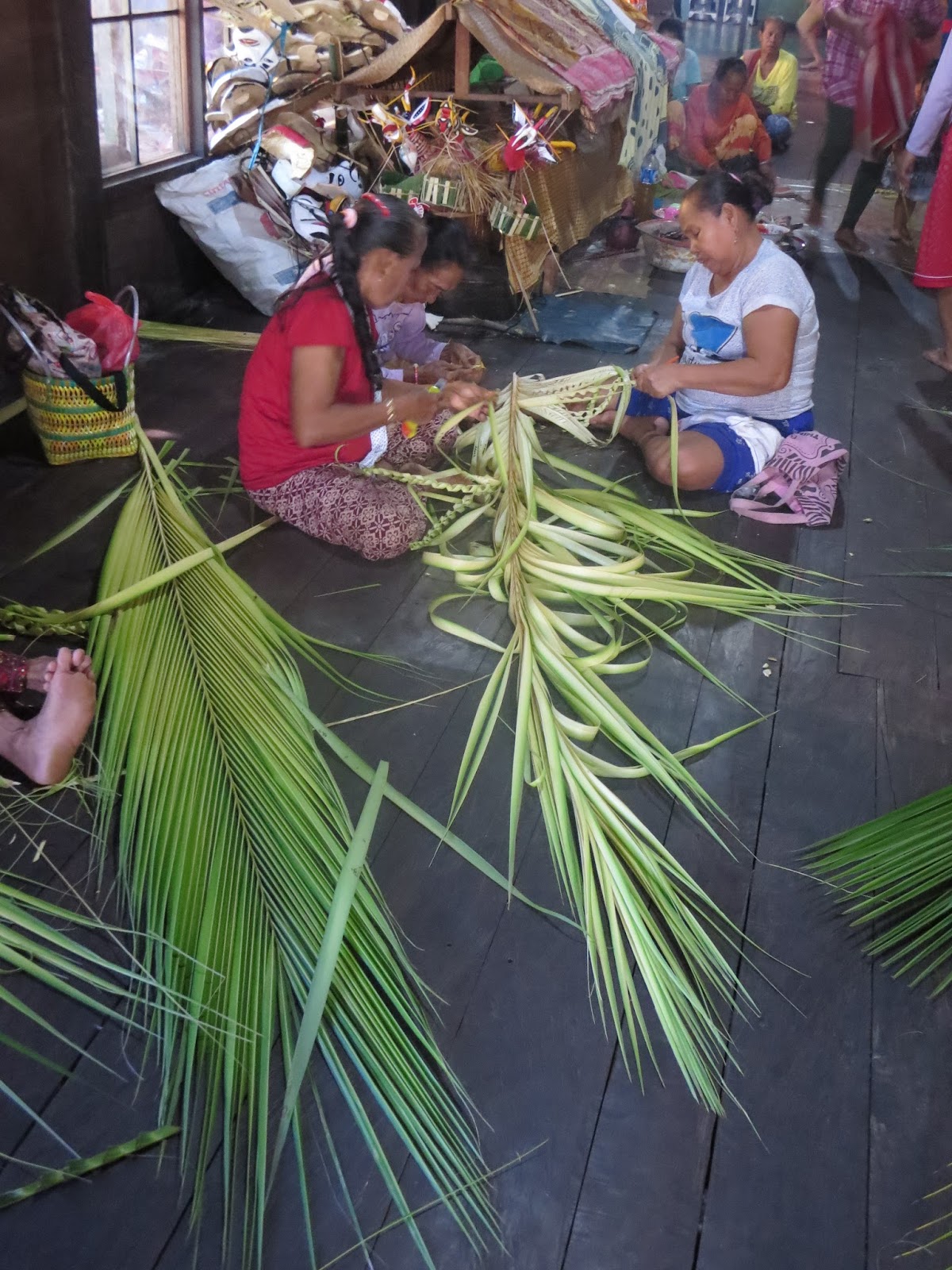
In this tiwah, the elder had lain for months in the front room of his home, and when we arrived the room was crammed with women, sitting with the widow, preparing the palm leaf woven decorations for the casket.
Out the back, women were preparing the ritual food, sweet sticky rice topped with fresh ground coconut tossed with the local palm sugar. Cattle, buffalo, pigs and chickens were sacrificed at regular intervals and boiled in huge vats with spices and vegetables over open fires, stirred with canoe paddles. They were feeding their own village, a neighbouring community and visitors too.
Waves of masked and draped figures, called bukungs, wearing painted flamboyant masks, lake weeds or a bamboo batik covered frame for the giant bukung santiau, came by day and night. With the role to frighten away mischievous spirits. They are welcomed, and repeatedly fed with sticky rice
and the local fermented drink, baram.
With the vast Lake Sembuluh as a backdrop, and the impassive, timeless faces of the sapundu from past tiwah on sandung scattered about the town, the passion of all involved, it felt as if we had stepped into the past and were living the myths and legends we had only read about.
Friday, April 22, 2016
Subscribe to:
Posts (Atom)